

 01.03.2026
 29 görüntülenme
Every year, while dozens of fairs, hundreds of events, and thousands of artworks overshadow each other during Miami Art Week, I find it remarkable that Pinta Miami manages to carve out a distinct space with its Latin America–focused identity. Founded in New York in 2007, the fair moved to Miami in 2014 and has since functioned not only as a regional art showcase but also as a cultural barometer. Its creation of a stage that challenges Latin American art’s secondary position in the global art market is one of the key factors that keeps it unique even under the shadow of giants like Art Basel Miami Beach.
In its 18th edition in 2024, the fair hosted 45 galleries from 14 countries. Artists represented ranged from well–known figures in contemporary art to younger experimental producers, drawing over 16,500 visitors to The Hangar. The curatorial structure of the fair was also notable: the MAIN section brought together established galleries, RADAR created a discovery–focused area, and NEXT highlighted young artists and alternative forms of production. This structure transforms the fair from merely a market space into a comprehensive platform for understanding the socio-political and cultural dynamics of Latin American art. The 19th edition will be open to the public this year from December 4–7 in the same venue.
The historical weight carried by Latin American art [spanning colonialism, military dictatorships, mass migration, and identity struggles] resurfaces in different forms at Pinta every year. The fair hosts a variety of productions that combine heavy historical burdens with contemporary visual languages, offering the audience both a reckoning with the past and a glimpse into the future. In this respect, the fair demonstrates how Latin cultures reconstruct memory through art, effectively placing a conceptual framework that functions as a living archive before visitors like a lens.
Pinta’s other events in Lima [Peru] and Buenos Aires [Argentina] also demonstrate notable platforms. Pinta Lima positions itself as a fair emphasizing the regional context of contemporary Latin American art production, providing a stage for both local artists and the Latin American diaspora. This approach transforms PL not only into an exhibition point but also into a vibrant and critical laboratory for Latin American art. BAphoto in Buenos Aires, on the other hand, is considered one of the continent’s most prestigious photography fairs. Established in 2005, it serves as a focal point for regional galleries, artists, and collectors. Sections such as Open File, Fuera de Foco, and Special Projects [similar to the segmentation in Miami] make both documentary and archival approaches as well as experimental productions by young photographers visible. Buenos Aires’ cultural infrastructure aims to turn BAphoto into a platform that conveys the history, memory, and current directions of photographic art.
Returning to Florida, the strong connections Miami maintains with Latin diaspora communities further reinforce the fair’s impact; the city’s large Latin population positions Pinta as a site of visibility and representation within Art Week. The professional profile of participants, as in many other fairs [where party environments are not the focus], is broad: curators, collectors, art historians, and independent writers follow the fair closely every year. The fact that sales results are mostly confirmed by galleries at the end of the fair has made Pinta Miami a significant player not only culturally but also financially.
As discussions on identity, cultural heritage, and representation accelerate in the global art market, Pinta Miami has become one of the most important stops in this conversation. Rather than confining Latin American art to a folkloric or exotic category, highlighting its contemporary advances, conceptual extensions, and aesthetic sensibilities positions the fair in a critically valuable role. Of course, like most other fairs I reviewed during this week, I cannot claim that decorative or sales–oriented gallery perspectives do not overshadow diaspora activism. In the transmission of stories, how the gallery or curator situates the production, and how the context is presented to the audience in terms of documentation and format is always the key factor in operational success, or failure.
So, a visitor experiences the fair in two ways: 1) Latin American culture has ideas, concerns, and values as they are perceived, and these are reflected in the production and background of the projects. 2) The participating artists are Latin American and produced these works. In fact, if one disregards conceptual works, I do not perceive a fundamentally different artistic language here, due to the global nature of contemporary art language. On the contrary, the fair is entirely compatible with the mainstream visual language of art week events. Cultural differences appear less in production methods and more in color palettes and the themes of works.
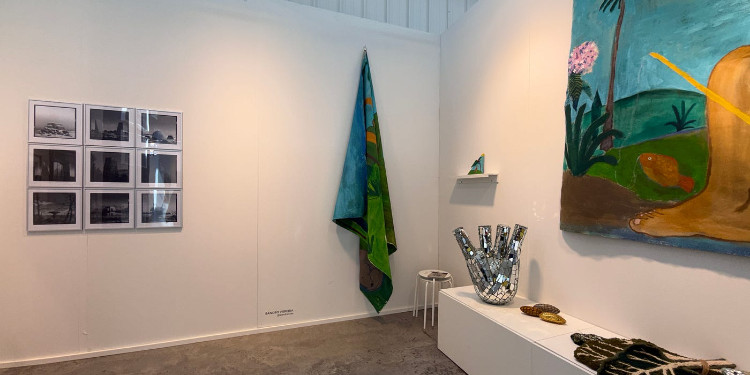
The areas designated for networking are spacious and located in a garden–like setting; they are purposefully designed, nicely isolated, and not boring. Organizing the fair in a hangar relieves the compressed ceiling feeling present in some simultaneous fairs. While I cannot say that the artwork texts are highly detailed, they are adequate; encountered the same situation I described in previous articles. I found some works more effective than others and requested information from galleries. They responded via email, providing work photos, artist names, titles, year, dimensions, and technical information. Since these details were already displayed next to the works in the exhibition space (and I photographed them), I still did not receive the curatorial texts or additional artist information not available on the web. Additionally, considering Pinta’s international scope, participating galleries must have English options on their websites. I frequently encountered this problem both at the fair and at other galleries I visited in the U.S. The artist might have produced or completed the work with Spanish texts, and the gallery presents it to viewers without any context or explanation. The audience’s attention span is already very limited; some come to photograph colorful works, some to see people and be seen, some to socialize or follow trends, and some to study contemporary art. In this environment, imagining a healthy internet connection, a curious audience, and active use of Google Translate is unrealistic. If I complete my piece in Turkish, another artist does it in Greek, another in Russian… and suddenly, a visitor unfamiliar with the work’s language leaves without engaging with it. Noticed the complication? A work created to tell a story may go misunderstood due to gallery/artist miscoordination and some lack of vision. The gallery, as the partially profitable party, is fine because decorative works are already presented out of context; the context will weaken or disappear in the exhibition space or the collector’s home.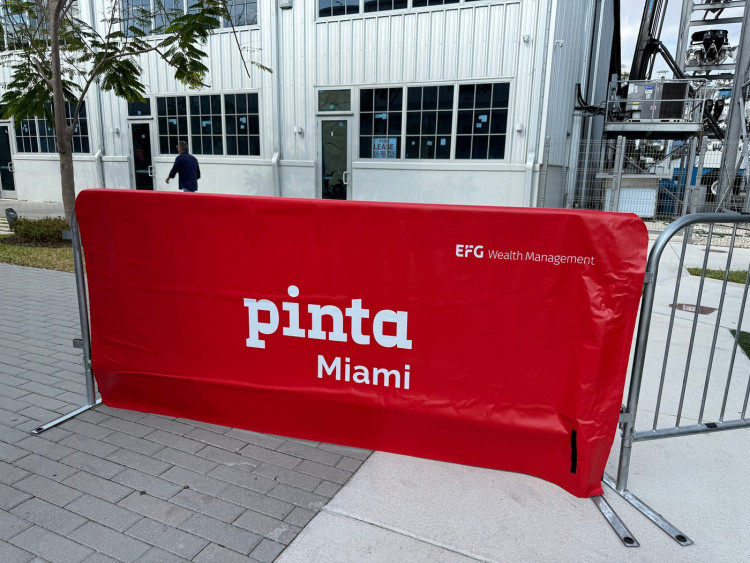
From a sociological perspective, since moving from Turkey, I have noticed many patterns in the U.S. One is that while trying to end discrimination, there is a desire for identities to remain outside a homogenized ‘American’ identity. In other words, discrimination against the identities is supposed to end, yet these identities continue to define themselves in alternative micro/still–segregated categories rather than macro/unified ones. Communities are so distrustful of the word American [referring to the citizens of the U.S.] that, even when it appears in cultural/racial classifications of the country, they hesitate to include themselves within it. Unity or integration is often perceived as assimilation under the influence of remnants of colonial dominant culture. Historical differences in underlying concepts also make this hard to grasp. Americans struggle to understand the European–style nation–state model [and they name it racism] or the transformative effects of immigration policies because their country is built on diversity. Europeans and Asians often cannot understand why micro–identities in the U.S. do not rise to unified/higher identities. Turning to art, when every collector sees geometric or purely decorative works fitting their walls, the fair loses its socio-political, identity–centered structure; works that convey the artist’s concerns, history, and story in a satisfying way solidify the artwork’s position.
At the end of the day, Pinta, amid the crowd of Art Week, becomes increasingly important with each edition as a space that reconstructs and spreads Latin America’s visual, political, and cultural narrative in a contemporary language; it offers the audience discussion opportunities not only through exhibitions but also through the cultural layers behind them. In this respect, the fair should be seen as an event to be read, analyzed, and followed.
Miami Art Week Fairs: Pinta
Yorumlar (0)
Bu gönderi için henüz bir yorum yapılmamış.
Yorum Bırakın