
 18.02.2026
 12 görüntülenme
Art Basel is, above all, an ecosystem. It is a chain of fairs held in Basel (Switzerland), Miami Beach (USA), Hong Kong, Paris (France), and Qatar. The editions in Miami and Basel are recognized as the world’s largest art fairs. So much so that, by dominating nearly 20 fairs taking place in Miami during the same week, it effectively lends its name to the entire week. The 2025 edition of Art Basel Miami Beach, open to visitors from December 5–7, follows last year’s format: comparable to other major fairs, it presents both contemporary and modern art projects, organized by galleries [286 galleries from 38 countries] welcoming over 75,000 visitors in total. When many press texts describe the fair as “a marketplace, showcase, and platform for cultural exchange for collectors, curators, gallerists, and artists”, the balance between art and commerce becomes quite evident. Art Basel Miami Beach functions as a hub that shapes the dynamics of the global art market [whether one likes it or not] directly influencing artist valuations, collection strategies, and investment opportunities. In this sense, the fair can be considered a benchmark of the global art economy, serving as an important reference point both for observing artistic production and for analyzing market and cultural trends.
During the same dates, events with no official affiliation to the fair nevertheless use the name to organize and promote so-called ‘Art Basel Parties’, while gallerists and artists participating in parallel fairs often peak misleading PR efforts by claiming, “I exhibited at Art Basel”. Social media amplifies this confusion, with many art events taking place during that calendar framed as accredited or synchronized with the fair. In previous years, I have also seen and read reports of several Turkish [my origin country] galleries participating in other fairs yet falsely declaring that their artists “exhibited in Basel”. A recommendation to artists integrated into such events would be is to cross–check and verify the claims of those directing them with US–based institutions.
Art fairs are not places to learn contemporary or classical art; they are places to observe the selectivity of the market. Accordingly, Basel and many events held during the same week are often described within the art world as spaces where collectors decide whether “This painting would look better on my living room wall, or perhaps another sculpture in the center”. In this text, I focus on projects that stood out for me by breaking clichés and introducing novelty beyond the mainstream.
The ‘Code of Behaviour’ panel placed at the center of the foyer [00:05] communicates the venue’s rules to visitors in a clear and direct language. The organization emphasizes that appropriate behavior by all guests is critical to the fair’s security and proper functioning. Everyone is obliged to comply with the conditions accepted upon entry and the fair’s general conduct policies, with explicit notice that visitors may be removed if these rules are violated. The text goes on to underline the sensitive nature of contemporary art fairs. Protecting exhibited works, ensuring the safety of artists and gallerists, maintaining order in crowded spaces, and safeguarding each visitor’s experience within a framework of respect are cited as fundamental reasons for these rules; physical contact, disruptive behavior, or actions endangering the crowd are stated to be entirely intolerable. The lower section of the panel specifically includes an ‘Anti–Harassment Policy’, noting the intention to provide a safe and inclusive environment for all participants and clearly stating that any form of harassment, pressure, verbal or physical discomfort is unacceptable. In such cases, visitors are advised to contact staff or security immediately.
As for why I devote an entire paragraph to a single panel [partly because I have not encountered this elsewhere] this is one of the 2–3 fairs with the greatest global media visibility. Information that is typically relegated to fine print on the back of tickets or buried in website footnotes is made unavoidable to see at Art Basel Miami Beach. This is a fair where, in previous editions, security controlled crowds in front of works and even managed queues for photography. Despite all ongoing debates, the U.S. remains the most developed country in terms of the societal adoption and legal protection of freedom of expression. As I will elaborate in later texts through examples from my own work, international and/or regional audiences may [by missing the context or perhaps understanding it all too well] label any artwork as an ‘attack’ on their values. The wording on the panel is therefore valuable in clearly stating the organization’s stance against such potential incidents. In Turkey, due to the absence of personal space and the suppression of freedom of expression, projects are frequently interrupted or censored; in contrast, the U.S. offers a much broader spectrum of expression. Statements that, under the Turkish Penal Code, might be construed as ‘insulting’ parliament, religious values, the president, or individuals [even the use of words deemed profanity] fall under the constitutional amendments defined in 1787 in the United States, protecting the individual’s right to free expression. Having spent the first 35 years of my life in Turkey, I want readers to be aware of this distinction.
The works encountered at Basel and other venues we have previously discussed, in line with this reminder, can present harsh modes of expression that, in other countries, might force artists into self–censorship or prompt galleries to say, “perhaps we shouldn’t go into those topics”. The only real limitation on this uniquely practiced freedom in the US is the triangle of Political Correctness > Cancel Culture > Cultural Appropriation. An impatient or reactive audience that neither understands nor wishes to understand context can, by mobilizing this triangle [often with the support of contemporary social media] subject artists, writers, or any producer of ideas to backlash severe enough to end careers. It is an unpleasant feeling, but at least when you are excluded, your freedom is not taken away by the state. In the 2024 edition, I did not encounter any work operating at this scale of impact.
Colored walls are always better than the classical white cube. Not hanging the work on the wall but allowing the wall itself to become the form [04:59] is something else entirely. At the Ames Yavuz stand, active in Singapore and Sydney, there was a work that became the wall itself. Kaylene Whiskey used acrylic on linen for Come Party With Me!, yet the installation was such that one might think the wall itself had been worked on prior to the fair. Smaller images partially spill over the wall onto the stand number. I would welcome seeing such approaches more often.
The mobile application supporting maps and information meets the level expected of an event of this caliber. Even after the fair ends, there is much left to explore. On–site signage is quite effective, though not entirely sufficient; IKEA–style floor–mounted directional strips could have been efficient to manage the dense crowds. Floor plans appear frequently [07:02], and while one might assume it possible to plan a walking route to see everything, the non–three–walled booth structures makes this impractical.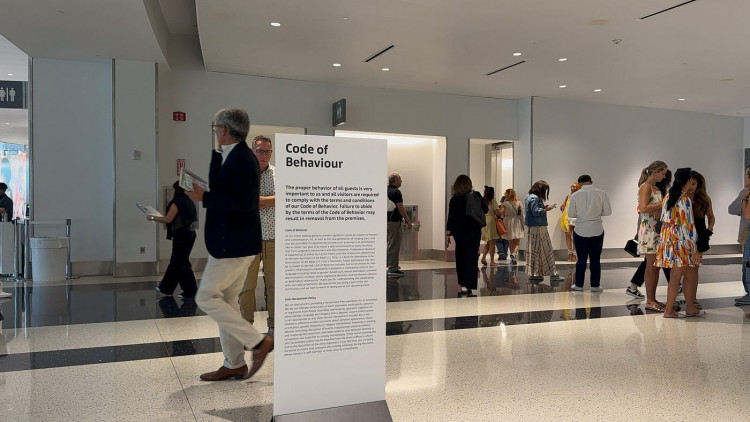
Julieta Tarraubella’s The Secret Life of Flowers [08:25] was an experience observing and documenting nature through technology. While cameras and screens initially drew me to the stand, the flowers organically rising along the walls were meticulously recorded at every stage by closed–circuit security cameras [from budding to death] rendering the entire process visible. The use of visual and auditory sources blurred human rhythms of life and perceptions of time, revealing the transient nature and limited duration of beauty. Through silent observation, the project invites viewers to reflect on surveillance, media, and power relations, questioning the boundaries between nature and its artificial representation. The gallery: Rolf Art, Buenos Aires.
Two bold approaches stood out in booth design. One involves incorporating walls and floors into the work or using color to separate the space from the general fair environment. The second, as demonstrated by Berlin–based Sweetwater [08:53], completely dismantles the assumed asymmetries of walls and the tradition of eye–level display. My favorite stand to watch was this unforgettable use, along with the Jesse Stecklow works presented on the floor. Stecklow’s practice intertwines data collection, material use, temporal markers, and research–documentation processes. By constructing a holistic system that reflects on reality, time, nature, human–material relationships, and materialism [rather than merely producing visual objects] his work offers a compelling challenge on both physical and intellectual levels.
Presented by Galerie Nicolai Wallner [19:44], David Shrigley’s Grid of 9 Anatomies offered a minimalist visual language I thoroughly enjoyed. You find yourself giggling and saying, “It really is that simple”, a delightful meeting of text and pared–down drawing. For those who appreciate minimalist, humorous illustration, I would also recommend exploring Jacob Shedeur’s works; wandering through these minds makes you want more.
At Peter Blum Gallery [34:23], I encountered a work by Nicholas Galanin (American Talking Stick). The eagle, typically integrated into American flagpoles, is wrapped around a police baton made of porcelain and embossed with presidential motifs. Having often presented batons as art objects in my own exhibitions on police violence and autocracy, I deeply appreciate Galanin’s material choices. Porcelain [historically tied to European colonial trade] embodies the fragility of the power structures it critiques, creating a delicate balance that symbolizes how violence and nationalism underpin American authority. By exposing contradictions within patriotic imagery, Galanin revives Indigenous ceremonial forms to resist systemic oppression and outdated histories.
At Victoria Miro, participating from London, Do Ho Suh’s Boiler Room [38:17] draws viewers with the feeling of experiencing another dimension. Made of polyester fabric and steel tubing, the fair installation allows limited interaction, yet I have also seen Suh’s works at the Margulies Collection and LACMA; his visual language is unforgettable. Passing through the large–scale works further amplifies the sense of an alternate dimension.
Sonya Rapoport’s String Drawings [41:49], shown at the Casemore Gallery stand, immediately evoked complex, deep, narrative–driven emotions. The series is a striking example of early digital art, merging feminist symbols with computer printouts. Dot–matrix graphics combine chains of X chromosomes, vulva forms, and imprints taken from a plastic uterus to create layered visual structures. Inspired by Nüshu, a writing system used exclusively by women in China’s Hunan region, Rapoport named this symbolic language accordingly. Initially drawn to the aesthetics and physicality of computer printouts, she later adopted coding as an artistic tool, collecting data on her own ‘soft materials’, including shoe collections, nostalgic memories, and fluctuations in daily emotional states. Created between 1976 and 1979, these works not only offer early examples of integrating computer coding into art but also presciently anticipate the transformative role of computers and data in everyday life and artistic practice.
At the Los Angeles–based Luis De Jesus Gallery [43:10], Mimi Smith’s works from 1991/93 [such as Ready-Made: Corporate, Woman’s Work Is Never Done: Health / Cleaning] were on view. Her focus on time and confinement allows the artist’s motivation to reach the viewer directly. Watched with thoughts like “Yes, these tasks await me too” or “She’s right, these things shouldn’t be postponed,” the works establish a remarkable coherence between manipulated readymades and newly created elements. The placement of the screen containing the video was among the most professionally executed I encountered across the fairs this week. The gallery presented Smith’s two and three–dimensional works across various media. She defines her practice as a process exploring the relationship between social experience and personal life. After beginning with abstract painting in the mid–1960s, a sense of disconnection between her work and daily life led her, in 1965, to shift toward transforming clothing into sculptural objects. Believing women’s relationship with dress to be a more effective vehicle for ideas, she used domestic materials [plastic wedding dresses, steel–wool bathrobes, corsets made from rubber bath mats] to reflect personal transformations in her practice. From ironic works like the Knit Baby in 1969 to wall drawings of knotted cords matching the scale of household appliances, and later repeated words on paper and ‘word drawings’ derived from television news notes, Smith’s evolving practice reflects cycles of lived experience.
I was drawn almost magnetically to the Woosun Gallery stand [45:28] from Korea. With a confident line and an upright stance that seems to respond to the way art institutions accept fair dynamics and risk losing their backbone, the booth design positions itself decisively. Choi Byung–So’s works, using manipulated magazines and newspapers, confront the viewer. A pioneer of the Korean avant–garde, Choi studied Western painting at Chung–Ang University and worked throughout his career in Daegu, one of the gallery’s activity centers. His practice follows an experimental, conceptual line shaped around existence and absence, image and matter, knowledge and silencing. Beginning to use newspapers as material in the 1970s, his work has been interpreted as both an influence of the global avant–garde and a reaction to political repression and media control in Korea. His justified anger toward censorship led him to repeatedly black out newspaper texts with a ballpoint pen until the page darkened completely and approached tearing through friction. Though the surface may appear monotonous at first glance, the works bear traces of physical performance grounded in human labor, time, and repetition. They are essential for internalizing how information and words, once subjected to control mechanisms, become ineffective [reaching the same point as if they had never been presented at all]. For viewers who rush through the fair without engaging with the artist’s background, these might seem like mere scribbles on paper, which is why the detailed preparation of labeling is crucial.
Other compelling works addressing violence and autocracy greet viewers at the Eric Mouchet Galerie stand [46:58], based in Paris and Brussels. The conceptual language and coherence were mesmerizing. Unfortunately, artist names and work details were not provided in this section. Various assemblages made of trash, framed mirrors placed on the forehead of the Statue of Liberty [some identifiable as works by Kendell Geers] were present, though the gallery’s website offers limited detail.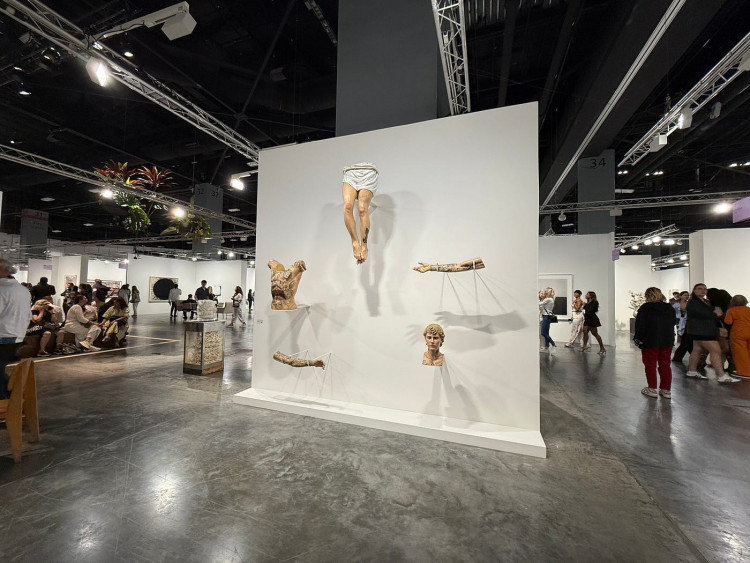
Paul Pfeiffer’s Incarnator series [54:02], seen at the Paula Cooper Gallery, was produced in collaboration with Filipino encarnadores [artisans who create religious icons through final layers of paint]. Observing this tradition during a residency in the Philippines, Pfeiffer decided to apply the same approach to contemporary icons. In the series, pop star Justin Bieber is transformed into a contemporary manifestation of Jesus, with each limb carved from wood and realistically painted. For Pfeiffer, Bieber symbolizes the circulation of viral images in the age of social media. Incarnator foregrounds centuries–old craft traditions while questioning the objectification of global icons’ bodies. By juxtaposing the role of religious icons in worship with the use of icons in celebrity culture, Pfeiffer reflects complex relationships between idolatry, innocence, and sexuality to the viewer’s mind.
I confess that, throughout my life, I have encountered frames at many fairs that were more satisfying than the paintings they held. I have attended countless exhibitions with deliberately low expectations, going merely to look at frames. Along these lines, I have seen many galleries that practice self–censorship on socio–political works, operate solely within guaranteed sellable visual languages, rent exhibition space to artists, avoid discovering unfamiliar voices, or pursue innovation only when sensationalism is assured. Art Basel Miami Beach aligns more closely with the second and fifth categories. My expectations of galleries are: openness to discovering new artists, and providing their staff with more comfortable seating and mobility spaces on fairgrounds than they currently do.
Miami Art Week Fairs: Basel
Yorumlar (0)
Bu gönderi için henüz bir yorum yapılmamış.
Yorum Bırakın